I have always been fascinated by sampling and its place in music history, especially electronic music history. Think about how a six-second drum break from the Winstons' Amen, Brother became the foundation for entire branches of jungle and drum and bass. Think about the break in Lyn Collins' Think (About It), or Clyde Stubblefield's groove on James Brown's Funky Drummer. Tiny pieces of old records became musical languages of their own.
That is the thing I love about sampling. You hear possibility inside something that already exists, pull it out of its original context, and give it a completely different life.
My own approach has always been a little scattered in the best way. I might take a tiny piece of one song, a little piece of another song, something that is not even a song, a field recording, or some strange sound I found in a video. I do not want one source to do all the work. I like gathering little fragments and figuring out what they can become together.
A lot of the time, I find those fragments on YouTube. That is where the problems used to start.
The old remix workflow was a mess
I make a lot of remixes and bootlegs to play in my sets. If I wanted to remix a track, the dream was always to find the studio acapella. I would search YouTube, download it through some sketchy YouTube-to-MP3 site, and start rebuilding the song around the vocal.
If the acapella did not exist, I might look for a karaoke version or a nearly perfect instrumental. If the instrumental lined up exactly with the original, I could sometimes use phase cancellation to remove most of the music and leave the vocal behind. That technique is hit or miss and only works in very specific situations, but when it worked, it felt like magic.
Stem-separation services eventually gave me another option. I used tools such as Moises and similar web apps, but for years the results were not close to a studio acapella. The vocal would have watery artifacts, drums would leak into everything, and the separation would sound obvious the second it was played loud.
Even when the result was usable, the workflow was ridiculous. Find the song on YouTube. Open a converter covered in popups, redirects, and fake download buttons. Get the MP3. Upload it to a paid stem service. Wait. Download the stems. Open another tool to find the key and BPM. Search for the chords. Find the tiny section I actually wanted, crop it, rename everything, and finally drag it into Ableton.
I was doing all of that just to find out whether the idea in my head was any good.
Then the command line gave me an unfair advantage
The turning point actually came from video. I was downloading YouTube clips for visuals and trying to crop out only the few seconds I needed. The normal tools made that annoying, so I started learning command-line methods. Once I was comfortable doing that, I found command-line tools for downloading audio, analyzing it, and separating stems too.
At the same time, locally hosted stem-separation models got dramatically better. This year, the best local models reached a point where they could blow the mainstream paid tools out of the water. I started experimenting with UVR and different models on my own computer, then built a series of command-line instructions around the way I actually sampled.
It took a lot of technical setup. I had to install dependencies, manage packages, keep track of model files, and know what commands to run in what order. But once it worked, it was by far the best sampling workflow I had ever used.
I felt like I had a huge advantage over other producers. They would watch me work and see some crazy hacker shit. Then they would ask if I could split a track for them, pull out the clean vocal, or isolate one specific piece and send it over.
The tools were already powerful. The real problem was that normal producers were not supposed to know how to reach them.
I had this incredible sampling workflow, but you practically had to become a command-line hacker to use it.
So I put the whole thing behind a real interface
Remixer is everything I was doing from the command line, rebuilt as one simple desktop app with a nice interface and a one-click setup process.
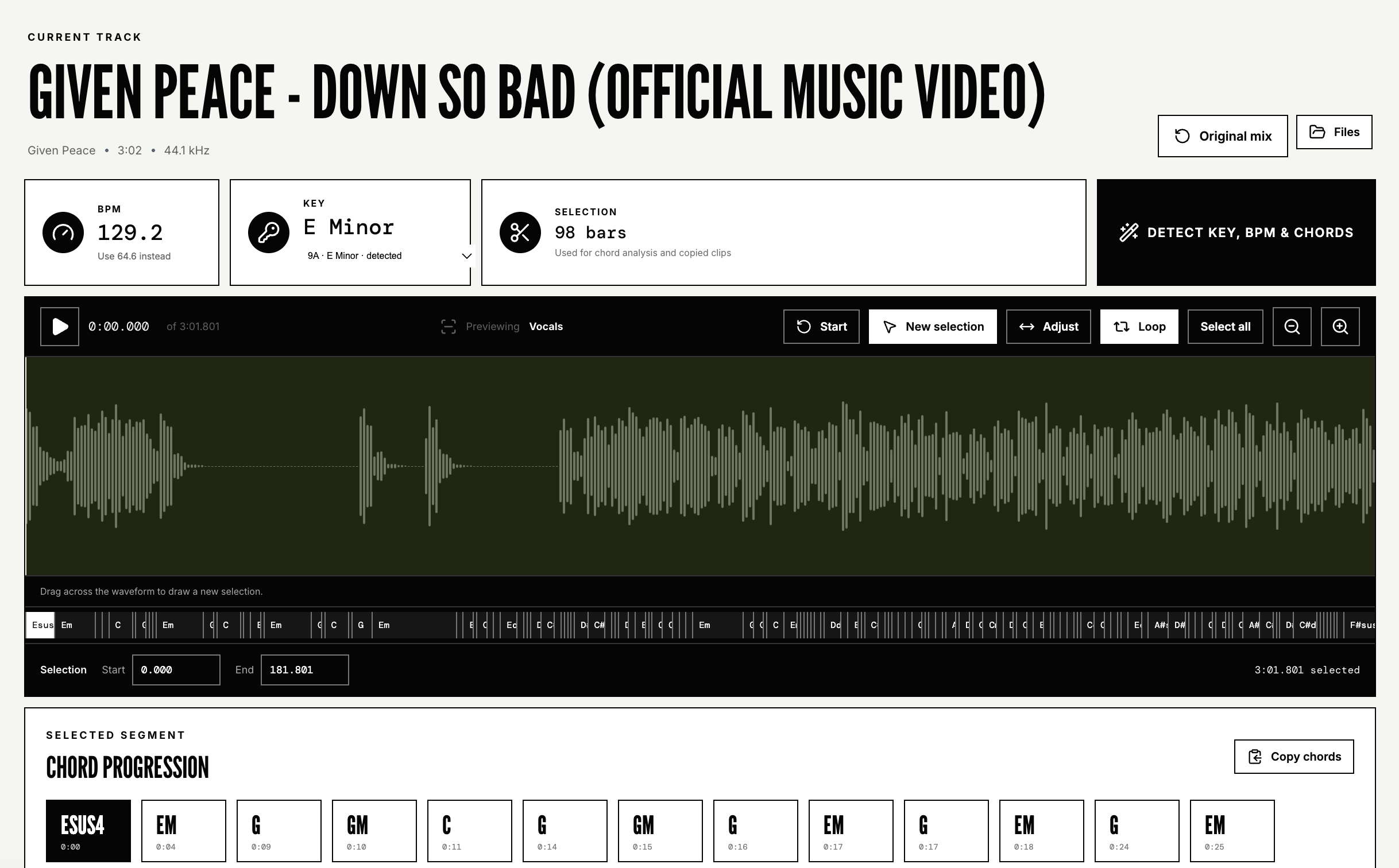
Open it, click Set Up Remixer, and let the app handle the technical part. Search for a song in the built-in YouTube browser. If every result is a music video, add the word lyrics to the search. That will often surface a cleaner version. Click Use in Remixer, wait a few seconds, and the track opens on the waveform.
From there, I zoom out and move around the song until I find the moment I care about. I drag across the waveform to make a selection, press the spacebar to listen, pause, move the selection, and keep going until I have the right section. Remixer can detect the BPM, key, and chords for that area, highlight each chord as it plays, and jump directly to any chord in the progression.
I can copy the selected part of the original mix straight to my clipboard and paste it into Ableton, FL Studio, or another DAW. Then I run the stem separation. Remixer processes the full track into six stems or a higher-quality vocal, lets me preview each result, and gives me the choice to copy the complete stem or only the exact section I selected. I can also copy every full stem or every selected section at once.
Then I click Copy, switch to my DAW, and click Paste. The audio lands directly in the session. That is it. No Finder or Explorer step. No sketchy converter. No separate chord site. No upload to a stem service. No folder full of mystery downloads.
Why it is free and why it runs locally
We talk about the music industry like it is made entirely of stars who earn millions of dollars. The reality is that a lot of the hardest-working producers are barely scraping by. They are living the starving-artist life, trying to get better while paying for a DAW, plugins, sample libraries, distribution, promotion, storage, and twenty or thirty random subscriptions.
I am in that position too. The last thing I want to do is make money by adding another bill for people who are struggling to make music.
I benefited from free tools. When I could not get access to something for free, I sometimes pirated it. That is the reality of being a broke producer. You make do with what you have because the desire to create does not wait until your bank account is ready.
Software is more accessible to build than it has ever been. People in music should use that opportunity to take back some power, give each other more agency, and make serious creative tools that do not squeeze another monthly payment out of the community.
Remixer runs the stem-separation models on your own computer, not in a datacenter somewhere. There is no per-song fee, no credit system, no upload queue, and no subscription. On supported hardware it is free, local, and fast as fuck.
I do not want to make money by adding another bill for producers who are already struggling to make music.
This is machine learning, not a build-me-a-song button
There is a huge difference between using machine learning for stem separation and using generative AI to make a song.
Stem separation removes busy work. It helps me get from the idea in my head to the part where I am making creative decisions. The same is true when machine learning is used for analysis, cleanup, or other production work that makes an artist more efficient without replacing the artist.
Generative music does something fundamentally different. It bypasses the creative process. You ask for a thing, press a button, and the thing exists. The artist's hands, ears, taste, practice, mistakes, and choices can disappear from the middle.
Nothing about Remixer removes the creative process. It does not decide what to sample. It does not decide how to chop it, repitch it, rearrange it, process it, play it, or build a new song around it. You still have to do the work. You still have to bring the creativity. You still have to make all the choices producers have been making for decades.
The dream of production technology should be to make it easier for the idea in our head to become real. The goal should not be to remove us from the process of making it real.
Remixer is not a build-me-a-song button. You still have to do the work, and you still have to bring the creativity.
Please make something I never expected
Remixer launches August 24 for Windows and Apple Silicon Mac. The first setup installs the models locally, so it takes some disk space and a little patience. The current builds are also unsigned, which means Mac and Windows may ask you to approve the app manually. The download page walks through all of that.
Once it is running, I hope producers use it to make bootlegs for their sets, pull impossible vocals out of old songs, build new rhythms from forgotten breaks, chop field recordings, and find tiny sounds nobody else would have thought to notice.
Honestly, my hope is a little selfish too. I hope somebody downloads one of my songs, splits it apart, resamples it, and makes some cool shit with something I made.
I will not be mad.
Sample me.